

Electricity is a cost every business carries, and many of them have rooftop space they never use. But what if your biggest rooftop isn’t where your biggest power bill is?
Two arrangements, Group Net Metering (GNM) and Virtual Net Metering (VNM), let eligible businesses and consumers share the benefits of one solar plant across several locations.
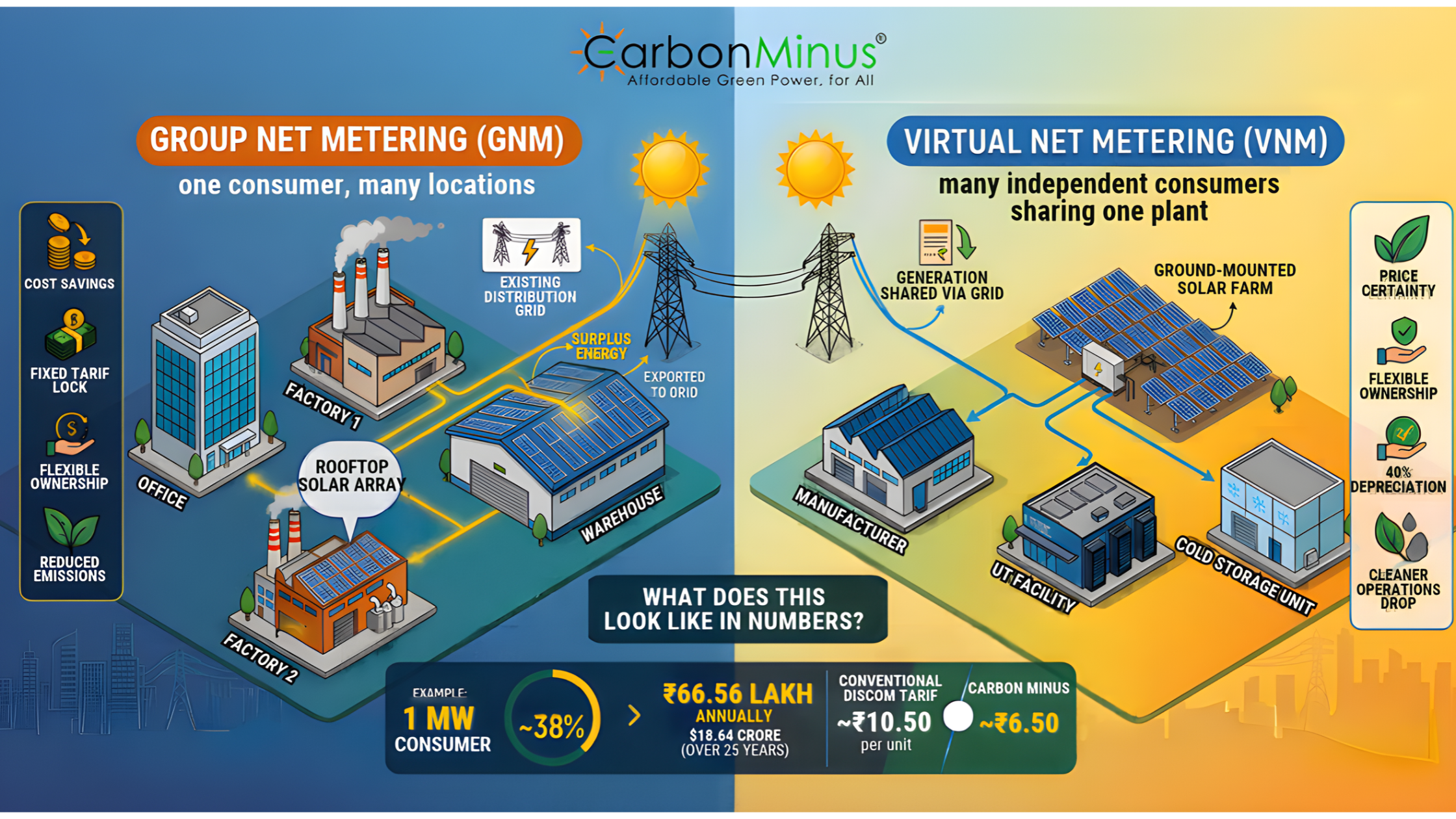
Group Net Metering: one consumer, many locations
GNM is for a single eligible consumer with multiple electricity connections. Say a company has a factory, an office and a warehouse. The factory roof has plenty of space, so the solar plant goes there. Surplus power is exported to the grid and eligible credits are adjusted against the electricity bills at the other locations. Subject to applicable regulations.
Virtual Net Metering: many consumers, one plant
VNM is for multiple independent consumers sharing the benefits of one solar plant. A manufacturer, an IT facility and a cold-storage unit could potentially share the generation from the same installation. Subject to the applicable regulatory framework.
In both cases, no power travels through private cables. The existing distribution grid carries the electricity, and the DISCOM handles the applicable credit accounting.
What businesses gain
- Lower costs: Carbon Minus offers an indicative renewable energy tariff of about ₹6.50 per unit, compared with the illustrative conventional DISCOM tariff of ₹10.50 per unit. This represents a potential saving of approximately 38%, depending on the applicable tariff and project structure.
- Price certainty: A 25-year fixed tariff PPA can provide greater protection against conventional electricity tariff fluctuations, subject to agreed contractual terms.
- Flexible ownership: Choose a developer owned model with zero upfront CAPEX, joint investment, or full ownership of the solar asset.
- Tax benefits: Eligible businesses owning solar power generating systems may claim depreciation at a rate of up to 40% on the Written Down Value (WDV) basis under applicable income tax provisions.
- Cleaner operations: Renewable electricity procurement can help reduce a company’s Scope 2 emissions. It also supports India’s clean energy transition. Eligible projects may additionally explore carbon credits as a potential source of revenue.
What does this look like in numbers?
Take a typical 1 MW consumer. A plant at 19% CUF generates about 16.64 lakh units a year At ₹10.50 from the DISCOM against ₹6.50 from Carbon Minus, that is an illustrative annual saving of about ₹66.56 lakh. Over 25 years, the illustrative saving is about ₹16.64 crore, assuming constant annual generation and tariff difference.
Is it right for you?
It suits businesses with multiple electricity connections and varying rooftop availability, such as retail chains, hospitals, manufacturers and logistics operators. Eligibility depends on state regulations, consumer requirements and the relevant DISCOM, so a site-specific assessment is the best first step.
You don’t need a solar roof at every location. You need a smarter way to use the one you have.
Talk to Carbon Minus:
info@carbonminus.in | www.carbonminus.in | +91 6291522234
Disclaimer: GNM and VNM are subject to state regulations, DISCOM approvals and consumer eligibility. Tariffs, savings, depreciation benefits and carbon credit opportunities are indicative and depend on project-specific assessments, applicable tax provisions and contractual conditions.