


When a company says it uses 100% renewable electricity, how can it prove that claim when power from solar, wind and coal plants flows through the same grid?When a company says it uses 100% renewable electricity, how can it prove that claim when power from solar, wind and coal plants flows through the same grid?
Renewable Energy Certificates (RECs) help answer that question. They track the renewable attributes of electricity separately from the physical electricity itself.
The Problem RECs Solve
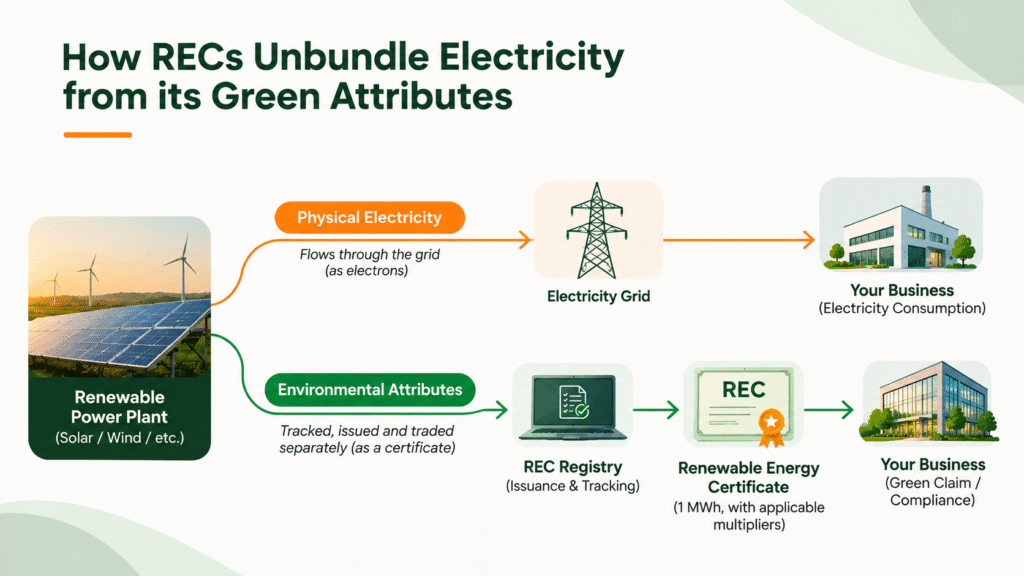
Once electricity enters the grid, electrons from different sources mix. A factory in Pune cannot identify whether its electricity came from a solar plant or a coal-fired station.
A REC represents the renewable attributes associated with electricity generated from an eligible renewable source. In India’s REC framework, the base unit is one megawatt-hour (MWh), with technology-specific multipliers under current regulations.
The electricity travels through the grid, while its renewable attributes can be tracked and transferred separately. This is known as Unbundling.
How the REC Mechanism Works in India
Introduced in 2010, India’s REC mechanism is regulated by the Central Electricity Regulatory Commission (CERC).
The process broadly works as follows:
- Accreditation: An eligible generator applies through the relevant State Agency or Regional Load Dispatch Centre (RLDC).
- Registration: The generator registers with the Central Agency, the National Load Dispatch Centre (NLDC).
- Verification and issuance: Electricity injected into the grid is verified. The Central Agency issues certificates based on verified data and applicable technology multipliers.
- Trading: Certificates are traded through power exchanges such as IEX and PXIL, subject to applicable rules.
- Redemption: Once used for an eligible compliance or reporting purpose, a certificate is redeemed or extinguished. It cannot be sold or claimed again.
Buyers include entities with renewable purchase obligations and businesses making eligible renewable electricity claims. As regulations evolve, buyers and generators should check the latest CERC rules and REC Registry procedures.
What About I-REC?
Internationally, companies may use Energy Attribute Certificates such as I-REC(E), which tracks renewable electricity attributes. These certificates can support voluntary renewable electricity claims and market-based Scope 2 reporting where accepted by the relevant reporting rules. I-REC(E) is also available in India.
Different systems have different requirements. Buyers should check the certificate’s market, generation period, tracking and retirement rules and whether it is accepted for their intended claim. Indian RECs and I-REC(E) are not automatically interchangeable.
REC vs Carbon Credit: What’s the Difference?
The two instruments are often confused, but they represent different things.
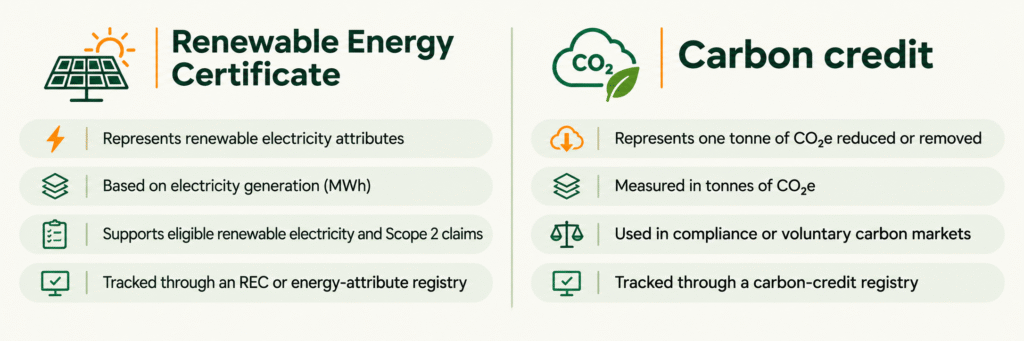
Buying RECs does not give a company carbon credits, and buying carbon credits does not make its electricity renewable. Both can complement a climate strategy, but they are not substitutes.
There is also a double-counting risk. When renewable attributes are transferred to a certificate buyer, the generator should not make an overlapping claim to those same attributes. Whether a project can issue both RECs and carbon credits depends on the applicable programme and methodology; the claims must be checked to avoid counting the same environmental benefit twice.
What Makes a REC Credible?
Before relying on a certificate, a business should check for:
- Verified generation: A link to an eligible generator and verified electricity data.
- Traceability: A unique ID and clear source and generation-period information.
- Clear ownership: No overlapping claims to the same renewable attributes.
- Retirement: A record of redemption for the relevant buyer and purpose.
A company’s public claim must match what its certificate proves. A REC does not, by itself, prove that every unit of electricity a business physically consumes came from renewable sources or that it has eliminated all emissions.
RECs may not be the most visible part of the energy transition, but they connect renewable generation with electricity consumers through a system of tracking. Carbon credits answer a different question: how much greenhouse gas has been reduced or removed?
Understanding the difference helps businesses make climate claims that are clearer, more credible and easier to verify.
Carbon Markets Blog Series | Carbon Minus