

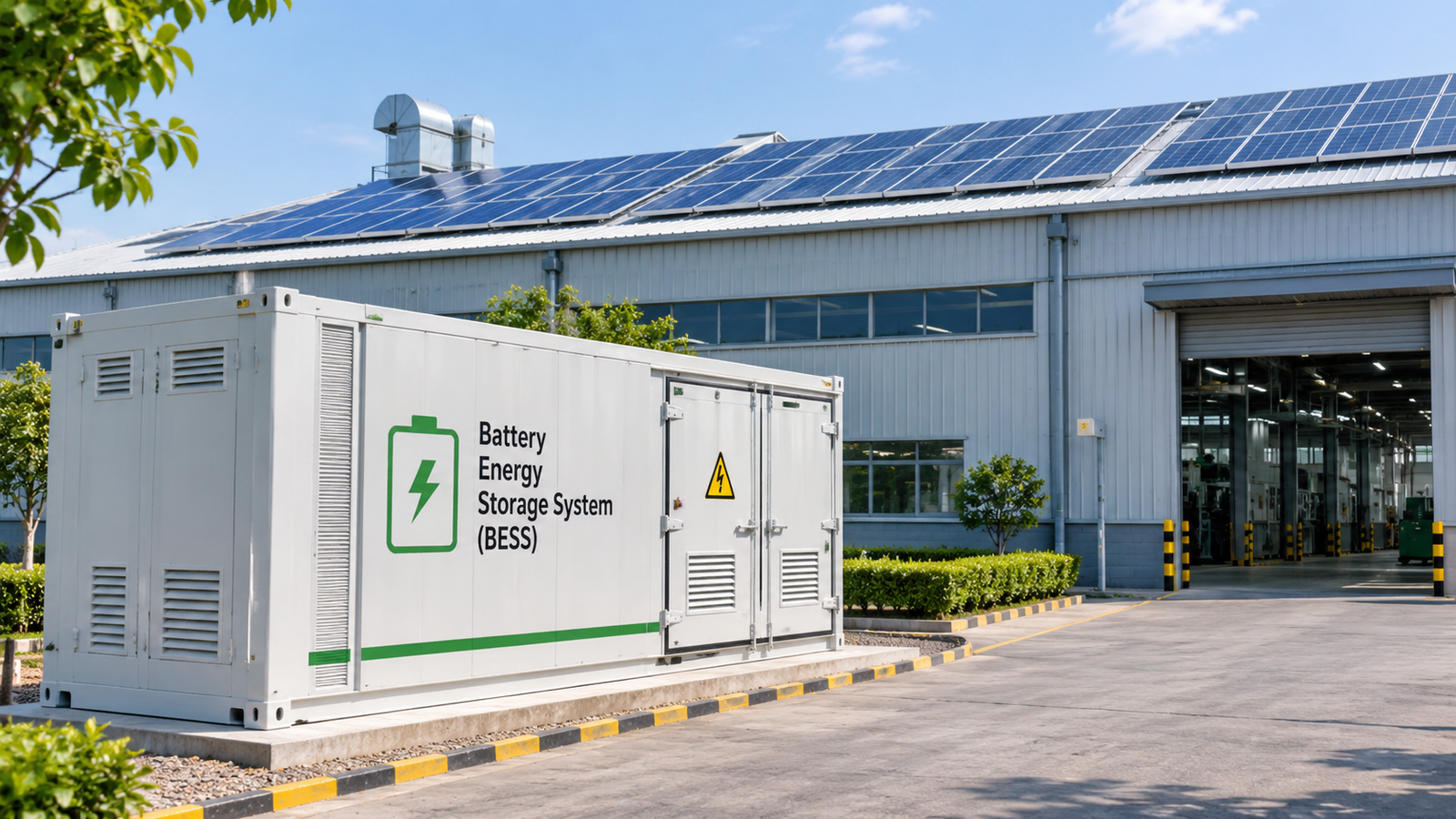
Battery Energy Storage Systems (BESS) are becoming an important part of India’s renewable energy landscape. With solar power available only during the day and electricity demand continuing into the evening, businesses are increasingly looking at batteries to make better use of the energy they generate.
But one question usually comes before the investment decision: how much does a battery storage system actually cost?
The answer is not as simple as the price of the battery. The final investment depends on the system’s size, operating requirements, installation and the infrastructure needed to make it work safely.
Battery prices are changing rapidly
Battery prices have fallen considerably over the past few years. Improvements in manufacturing and the growing scale of battery production have made energy storage more affordable than it once was.
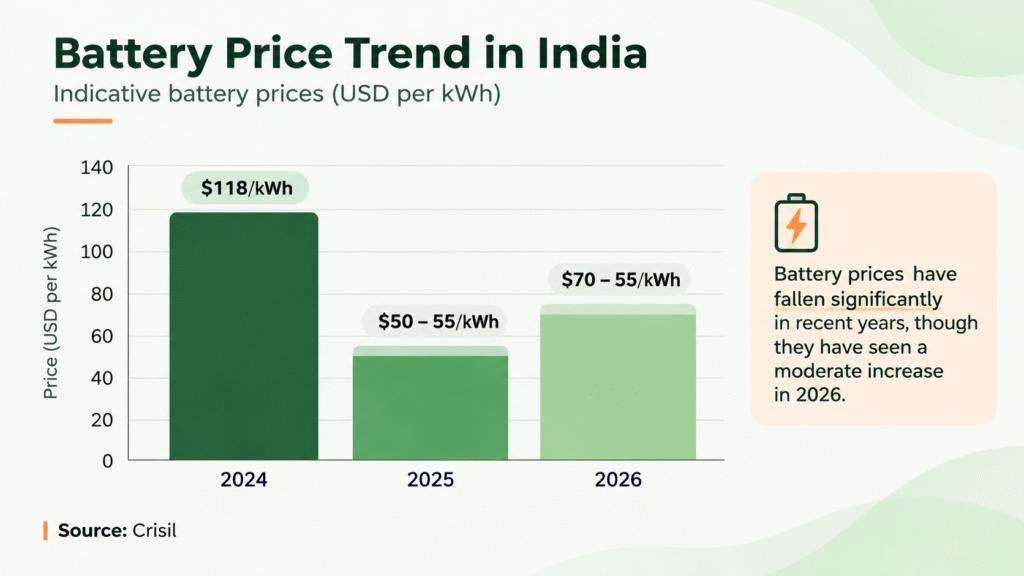
However, prices have not moved in a straight line. According to industry estimates reported by Crisil, battery prices fell from approximately $118/kWh in 2024 to $50–55/kWh in 2025. Prices then increased to around $70–75/kWh in 2026.
While this makes battery storage increasingly attractive, the battery itself is only one part of the total project investment.
What goes into the total cost?
A BESS installation involves much more than purchasing battery cells. Several components work together to store and deliver electricity when required.
The total project cost typically includes:
- Battery packs: Store electrical energy for use later.
- Power Conversion System (PCS): Converts electricity between AC and DC so the battery can charge and discharge.
- Battery Management System (BMS): Monitors the battery’s condition and helps keep it operating within safe limits.
- Thermal management and fire protection: Maintain operating temperatures and provide protection against potential hazards.
- Installation and electrical infrastructure: Includes cabling, transformers, switchgear, foundations and grid connection requirements.
- Control and monitoring software: Helps manage charging, discharging and energy usage.
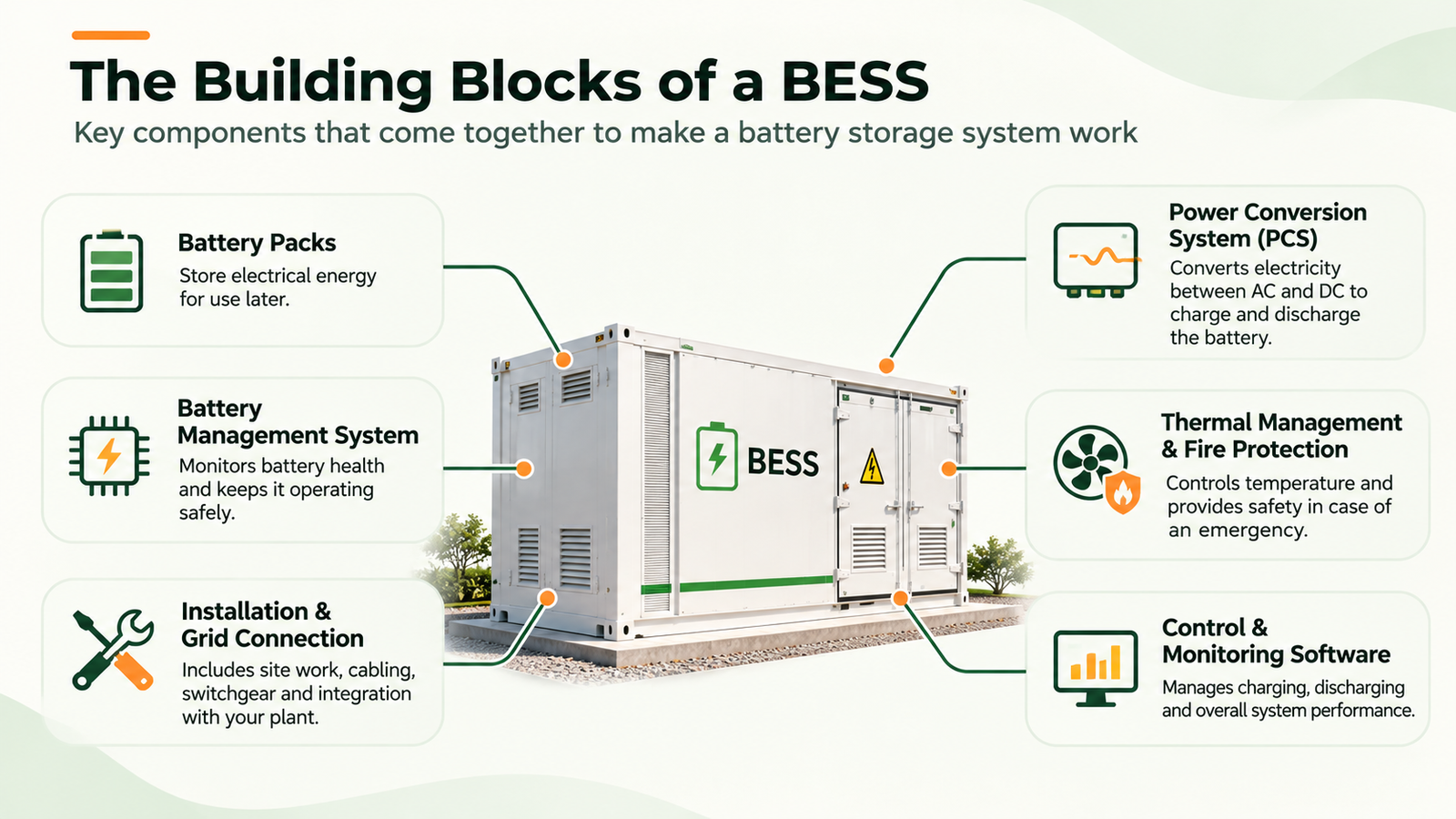
These additional systems are why the cost of a complete BESS installation is higher than the price of battery cells alone.
So how much does a BESS cost in India?
For large-scale projects, industry estimates place installed BESS costs in the range of approximately ₹10,000–₹13,000 per kWh, although project specifications and market conditions can change this considerably.
Smaller commercial and industrial installations may cost more per kWh. This is because equipment, engineering, safety systems and installation costs are spread across a smaller storage capacity.
A 100 kWh system and a 10 MWh system cannot be compared simply by multiplying the battery price. The infrastructure required for each project and its operating requirements can be very different.
Indicative BESS costs by application
| Application | Indicative installed cost |
|---|---|
| Small commercial systems (20–60 kWh) | ₹13,000–₹26,000/kWh |
| Industrial C&I systems (64–480 kWh) | ₹10,000–₹20,000/kWh |
| Larger C&I systems (500 kWh–2 MWh) | ₹18,000–₹32,000/kWh |
| Multi-MWh C&I projects | ₹15,000–₹28,000/kWh |
| Utility-scale installations | ₹13,000–₹18,000/kWh |
Indicative market estimates only. Costs vary based on battery technology, project size, installation scope, safety systems, electrical infrastructure and supplier quotations. These ranges are not standardized market prices.
For businesses, the quoted cost should always be evaluated against the complete system. Battery capacity alone does not determine the investment. Installation, power conversion, protection systems, site requirements and operating conditions all contribute to the final cost.
A project quotation should therefore clearly distinguish between the battery cost, equipment supply cost and total installed cost before any financial comparison is made.
What makes one BESS more expensive than another?
There are a few factors that directly influence the investment.
System capacity and duration: A system designed to deliver power for four hours requires more stored energy than one designed for an hour. This increases the battery capacity and overall investment.
Operating cycles: How frequently the battery charges and discharges affects its lifetime, degradation and maintenance requirements.
Site requirements: Space, civil works, electrical infrastructure, cooling and safety requirements can vary from one facility to another.
Battery technology and warranty: The battery chemistry, expected degradation, warranty period and replacement requirements all influence long-term value.

Does battery storage make financial sense?
The value of a BESS is not determined by its purchase price alone. It depends on how effectively it reduces electricity costs or improves energy utilisation.
For a business with high peak demand, a battery can help reduce demand-related charges by supplying power during periods of high consumption. Facilities with rooftop solar can also store surplus daytime energy and use it later instead of relying entirely on grid electricity.
But not every facility will benefit equally. A business with little evening demand or limited peak tariff exposure may not achieve the same savings as one with a more suitable load profile.
The investment should be evaluated using actual electricity consumption, tariff structure, operating hours and expected battery performance. Payback periods can vary significantly from one facility to another.
Before investing in a BESS
Battery storage is becoming more accessible, but the right system is not necessarily the cheapest one.
Businesses should look beyond the initial quotation and understand the complete installed cost. Ask about battery degradation, warranty coverage, maintenance, expected performance and the infrastructure included in the proposal.
Safety requirements and installation norms also influence the final investment. Understanding these before selecting a system can prevent unexpected costs later.
A BESS should be designed around how your business uses electricity. When the system is sized and operated correctly, battery storage can become a practical way to improve energy efficiency and manage electricity costs.