

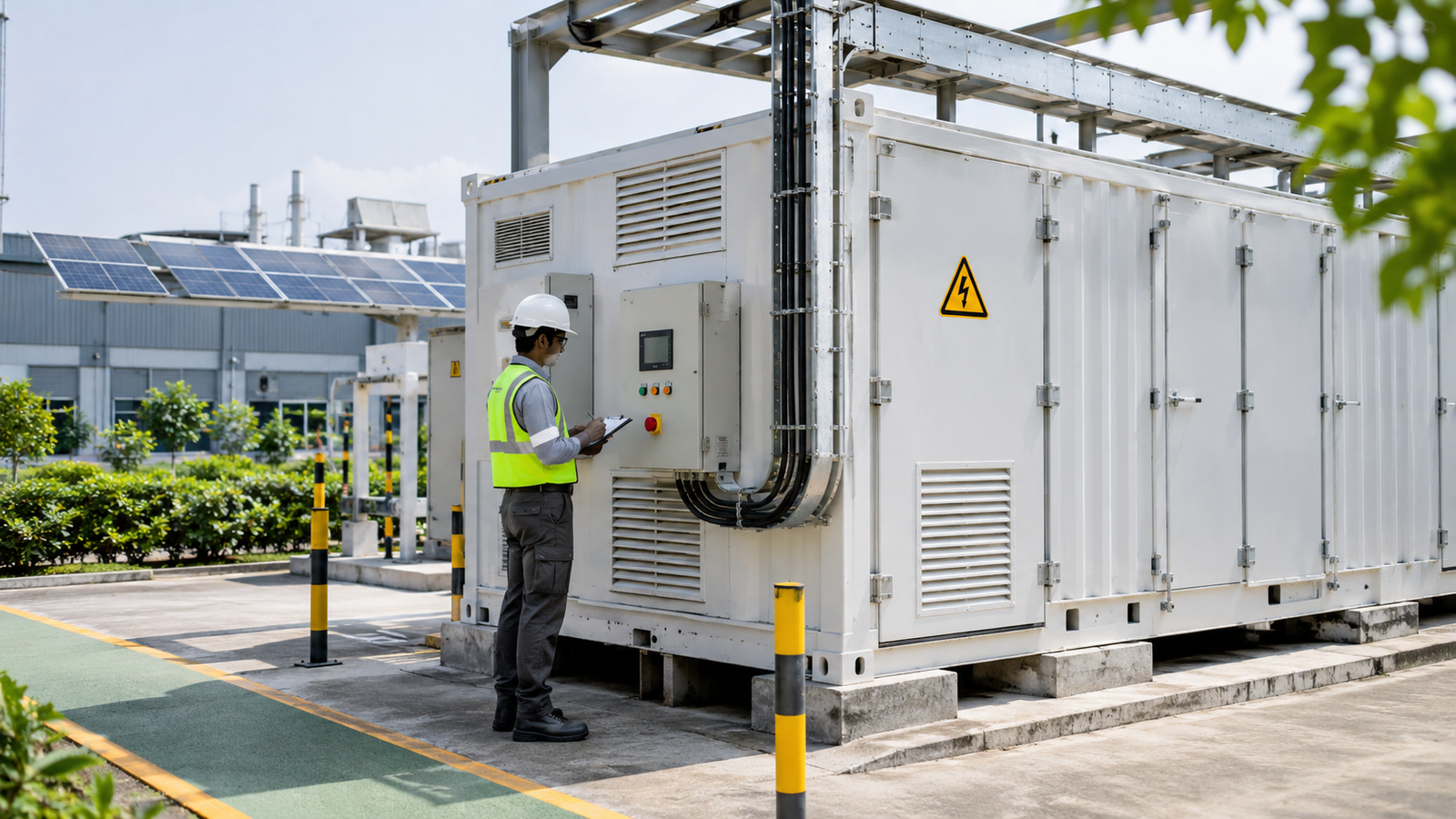
Battery storage is becoming more common across factories and commercial sites. But as more businesses look at installing these systems, safety needs to be part of the conversation from the beginning.
In March 2026, the Central Electricity Authority (CEA) notified an important update to India’s electrical safety regulations, introducing a dedicated chapter for Battery Energy Storage Systems (BESS). The CEA (Measures relating to Safety and Electric Supply) Amendment Regulations, 2026 were published in the Gazette on 30 March 2026 and will come into force on 1 April 2027.
The key distinction is the system’s connection voltage. BESS installations connected above 650 V fall under the full set of additional safety requirements laid out in Chapter XA (Regulations 122(A) to 122(N)). Installations connected at 650 V or below are outside the scope of these additional Chapter XA requirements. However, they are not exempt from electrical safety regulations. They must comply with Regulation 122(N), which requires adherence to the relevant applicable standards.
What the safety rules require
The new rules focus on preventing battery failures and limiting their impact if something goes wrong.
One of the key requirements is two-fault tolerance. A BESS must be designed to operate safely or shut down safely even after two independent faults occur. This is particularly important because a failure in one part of a battery system should not lead to a wider incident.
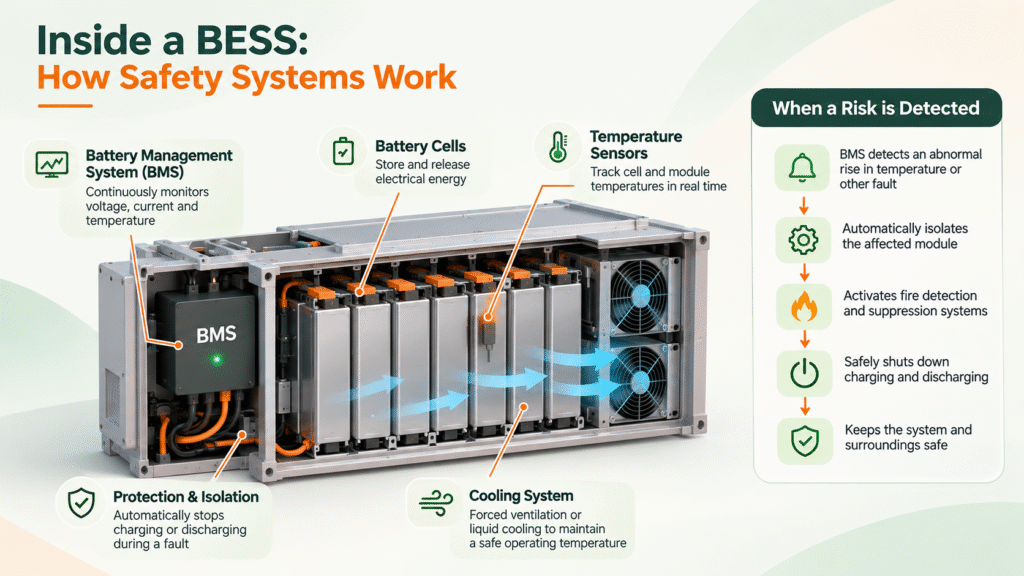
The Battery Management System (BMS) also has a defined role. It must monitor and record voltage, temperature and signs of thermal runaway at the cell, module and rack levels. Current must also be monitored and recorded at rack level. If monitored parameters move beyond the operating limits specified by the equipment manufacturer, the system must raise an audible and visual alarm. If battery temperature exceeds the manufacturer’s recommended values, the BMS must stop charging and discharging.
The power conversion system must be capable of operating automatically without continuous supervision. This includes synchronising with the electricity system and disconnecting when required. It must also have protective and diagnostic features to respond to component failures and abnormal operating conditions.
The rules also cover the battery enclosure. Containers must have explosion protection, including forced ventilation and automatic louvers to safely release flammable gases and control internal pressure. Heating, ventilation and cooling systems must maintain suitable operating conditions. Detection systems for smoke, gas, heat and flame are also required. Each battery container must have an automatic fire extinguishing system.
Site security and emergency response are equally important. BESS installations must be protected by fencing at least 1.8 metres high to prevent unauthorised entry. CCTV, suitable sensors and warning devices must be connected to a monitoring and response system. If a safety issue or battery failure is detected, the affected section must shut down automatically within the period specified by the equipment manufacturer. Manual emergency stop buttons or switches must also be clearly visible and easy to reach.
The fire safety audit
One of the most important compliance requirements is the independent fire safety audit.
For installations covered by the additional Chapter XA requirements, the owner must arrange an independent third-party fire safety audit within three months from the regulations coming into force. Since the rules take effect on 1 April 2027, this places the initial deadline around the end of June 2027.
The owner must submit the audit report to the Electrical Inspector at the time of inspection. The audit will follow a Standard Operating Procedure to be issued by the CEA.
For businesses planning new installations, the exact audit timeline for projects commissioned after the initial deadline should be confirmed with the relevant authorities and the project supplier.
One gap to watch
The regulations refer to relevant technical standards for several requirements including fire protection, ventilation, spacing and equipment safety. Under Regulation 137, the CEA is required to publish a separate list of applicable standards within three months of the regulations taking effect.
This list will be important for suppliers, EPC contractors and project owners. Until it is issued, businesses should ask suppliers to clearly identify the standards and certifications used in their proposed system rather than assume that a general product certification covers every site requirement.
Five questions to ask your supplier
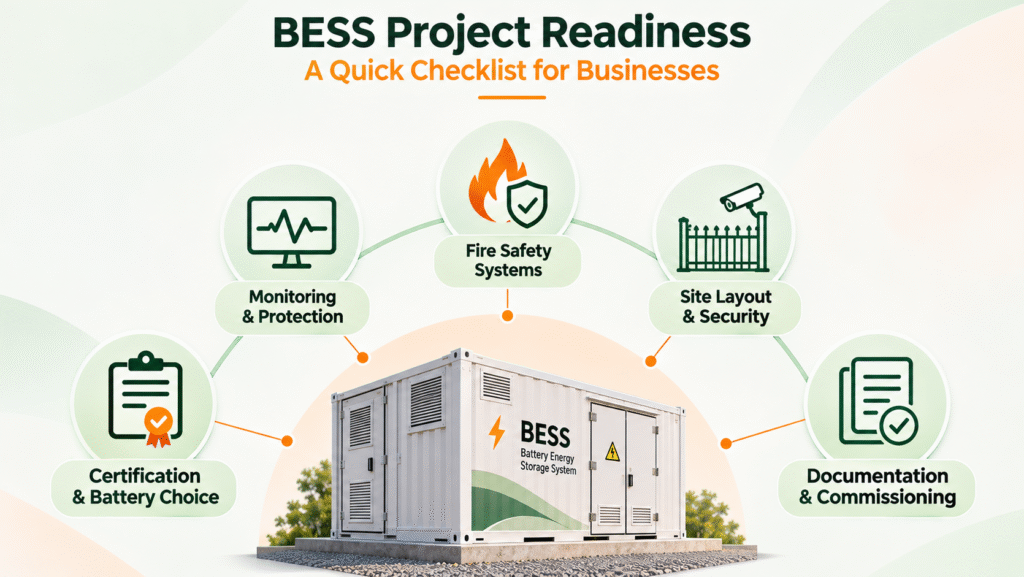
Before signing a BESS contract, businesses should get clear answers to these five questions:
- Battery quality: Which battery chemistry is being used? What safety standards and certifications does the manufacturer follow?
- Monitoring: Does the BMS monitor voltage, temperature and thermal runaway at the required levels? Are alarms and automatic shutdown functions included?
- Fire safety: What detection and suppression systems are provided? How are ventilation and gas build-up managed inside the containers?
- Site layout: Does the proposed layout account for the required fencing, equipment separation and emergency access?
- Documentation and responsibility: Who will arrange the fire safety audit, statutory inspections and commissioning records? Are these responsibilities clearly defined in the contract?
A reliable supplier should be able to explain these requirements before the project begins. The contract should also clearly identify who is responsible for safety systems, testing, documentation and the required audit.
What this means for businesses
The new CEA regulations make safety a central part of BESS planning in India. From 1 April 2027, installations above 650 V will have to meet the additional requirements under Chapter XA, while smaller systems must still follow the relevant applicable standards.
For businesses, the best approach is to consider these requirements before finalising the system design or selecting an EPC contractor. Ask for clear technical documentation, understand who is responsible for compliance and make sure safety provisions are built into the project from day one.
Battery storage is a long-term investment. Getting the safety and compliance aspects right at the beginning can help businesses avoid costly changes later.
One Response
Testing.