

A solar power plant generates clean electricity, reduces dependence on conventional power and contributes to reducing emissions. But should every solar project automatically qualify for carbon credits?
Not necessarily. The important question is whether the emission reductions would have happened even without the project or the incentive supporting it. If a project was already planned and would have gone ahead regardless, carbon finance may not have contributed to creating that environmental benefit.
This is where Additionality comes in.
What Does Additionality Actually Mean?
Additionality determines whether a project creates emission reductions beyond what would have happened under normal circumstances — and whether those reductions meet the requirements to qualify for carbon credits.
Consider two solar projects.
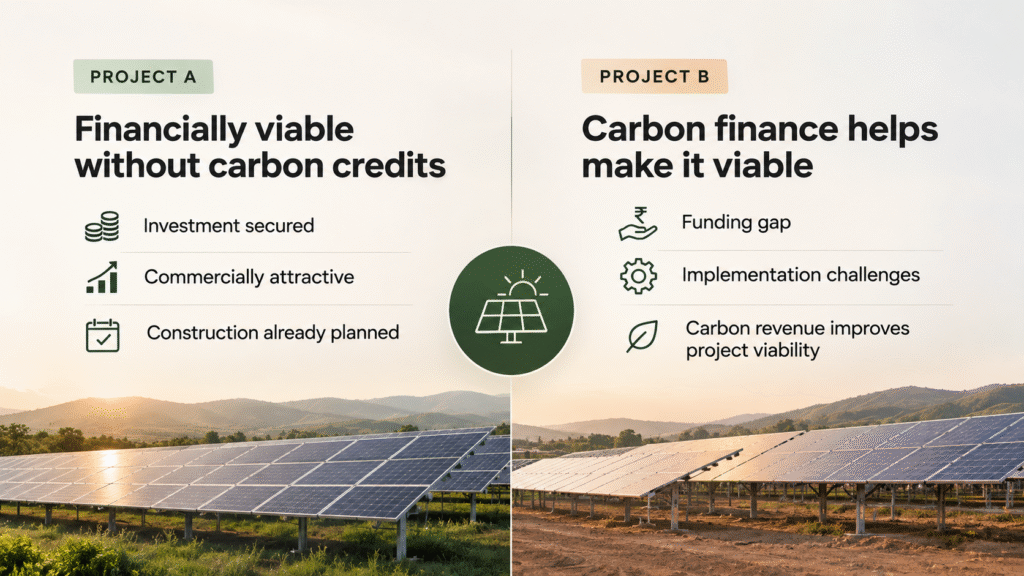
The first is planned in an area with favourable solar conditions. The developer has secured financing, the project is commercially viable, and construction is going ahead regardless of carbon-credit revenue.
The second faces financial challenges. The initial investment is high, returns are uncertain, and the project may not move forward without additional financial support. Revenue from carbon credits could help make it viable.
Both projects generate clean electricity. But if carbon finance played a role in enabling the second project while the first would have happened anyway, their eligibility for carbon credits may differ.
This is why additionality matters. Carbon credits are meant to support emission reductions that would not otherwise have occurred. Without additionality, a buyer could be paying for an environmental benefit that was already going to happen.
How Is Additionality Determined?
A project cannot establish additionality simply by claiming that carbon-credit revenue is important. It must demonstrate this through the requirements of the applicable carbon-crediting methodology.
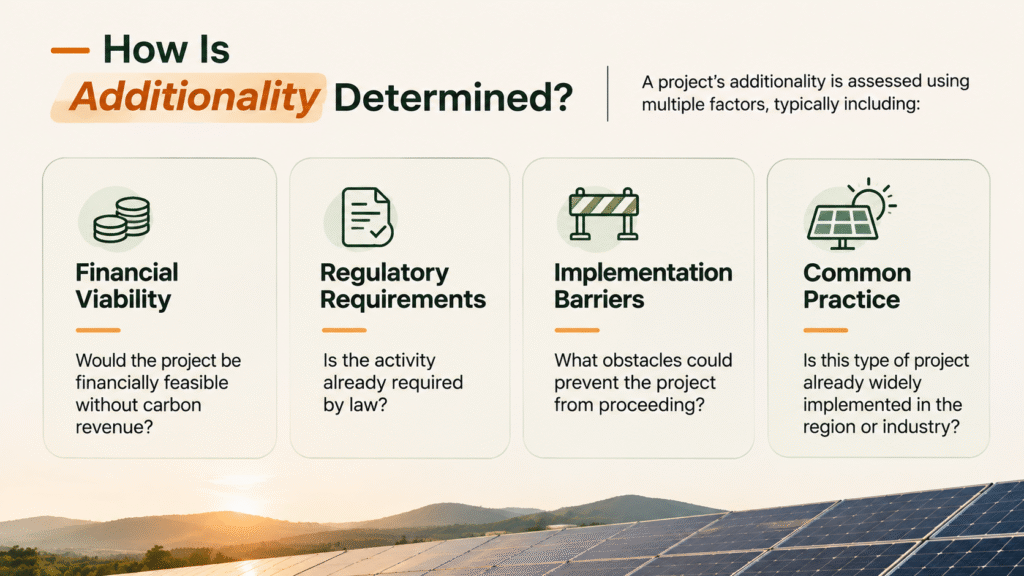
Some of the factors that may be assessed include:
Financial viability: Would the project be attractive enough to proceed without carbon-credit revenue? Carbon finance may help bridge a financial gap, but profitability alone does not determine additionality.
Regulatory requirements: Is the project already required by law? Activities undertaken simply to comply with mandatory regulations generally cannot claim additionality on that basis.
Implementation barriers: Are there financial, technological or other barriers preventing the project from being developed? Carbon finance may help overcome these barriers.
Common practice: Are similar projects already being routinely developed in the region or industry without carbon-credit support?
These assessments help establish whether carbon finance genuinely contributes to making the project possible. The exact requirements depend on the applicable standard and methodology.
Why Is Additionality Challenging to Prove?
The difficulty lies in assessing what would have happened if the project had never been developed or if carbon-credit revenue had never been available.
That alternative scenario cannot be observed directly. Assessments therefore rely on evidence, financial analysis, historical data and assumptions about what would most likely have happened.
If these assumptions are inaccurate or the barriers to implementation are overstated, projects may generate credits for emission reductions that were not genuinely additional. This is one of the reasons carbon credits are scrutinised and why independent validation and verification are important.
The Question Worth Asking
Carbon credits can create an additional revenue stream for projects while directing finance towards emission reductions. But not every environmentally beneficial project necessarily qualifies.
Ultimately, additionality comes down to a simple question:
If the carbon-credit revenue disappeared tomorrow, would this project still happen?
Understanding the answer is an important step in understanding what makes a carbon credit credible.