

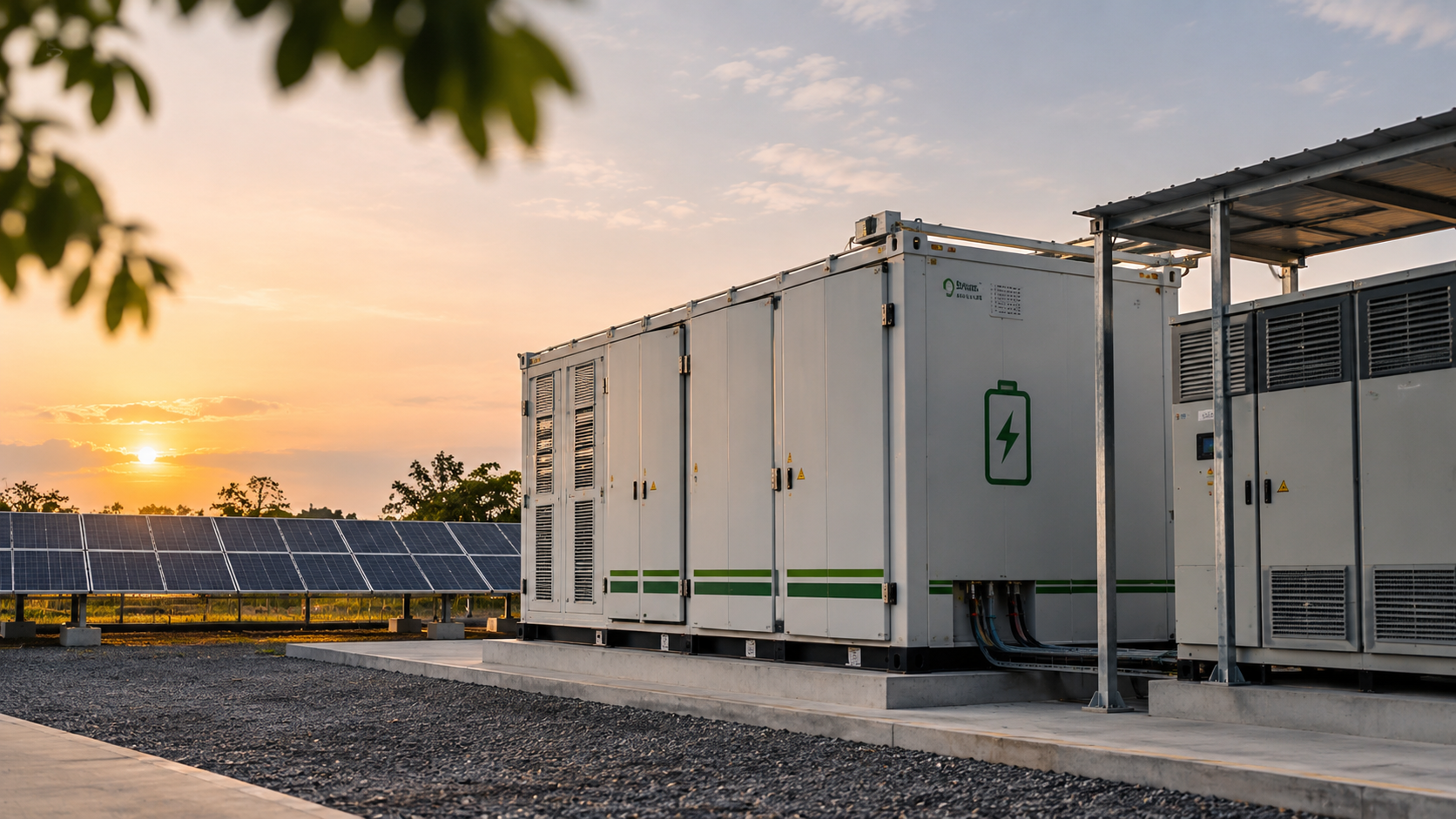
Ask a factory owner what they like about solar, and the answer is usually straightforward: lower electricity bills. But ask what happens when the evening shift begins, the machines are still running, and solar panels have stopped producing. That is where solar’s limitations become clear.
Battery Energy Storage Systems (BESS) help address this gap by allowing businesses to store electricity and use it later. Think of a BESS as a large power bank for your facility.
During the day, your solar plant may generate more electricity than you consume. Depending on your grid connection and metering arrangements, this surplus may be exported to the grid or go unused if it cannot be utilised or sold. A battery can store some of this excess energy for later. When solar generation falls, the stored electricity can be released to your facility, helping reduce dependence on the grid during evening hours or periods when electricity is more expensive.
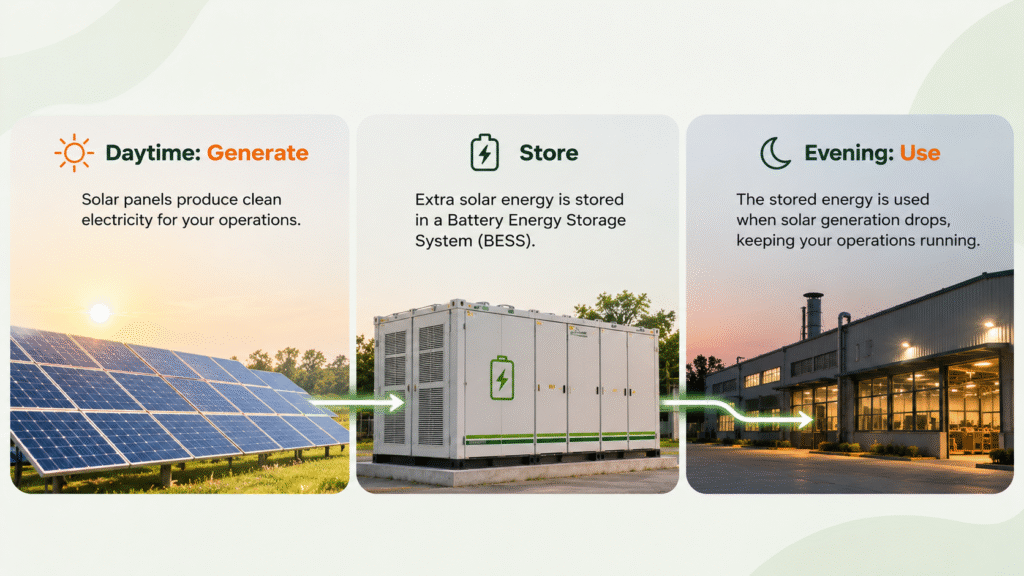
What actually makes up a BESS?
A battery storage system consists of three main components:
- Battery Packs: These store electrical energy, usually using lithium-ion technology. They accumulate excess electricity and hold it until it is needed.
- Power Conversion System (PCS): A bidirectional inverter that converts electricity between AC and DC. During charging, it converts AC electricity into DC for storage in the batteries. During discharge, it converts DC electricity from the batteries back into AC for the facility. Essentially, the PCS manages the flow of energy into and out of the battery system.
- Battery Management System (BMS): An electronic control system that monitors battery operating conditions, including voltage, current, temperature and state of charge. It helps keep the batteries within safe operating limits, protects them under abnormal conditions and manages cell balancing to support performance and battery life.
Where does a battery make a difference?
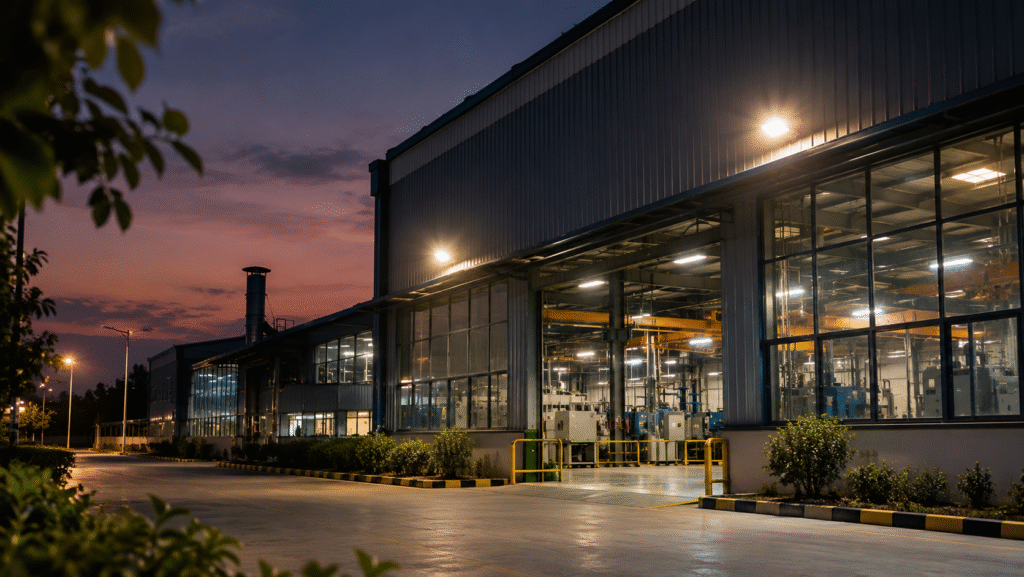
Making better use of solar power
Solar generation and electricity consumption do not always match. A factory may produce more solar energy than it needs during the afternoon but still have significant electricity requirements after sunset. Storage allows some of that surplus energy to be shifted to the evening. Instead of exporting it to the grid or losing it when export is restricted, the battery can store it for use when the facility needs it.
Managing peak demand
Many commercial and industrial electricity tariffs include demand charges based on the maximum power drawn during a billing period. If a facility experiences short periods of unusually high demand, a battery can discharge during those intervals to reduce the load drawn from the grid. This is known as peak shaving.
Depending on the tariff structure, reducing peak demand can lower electricity costs, particularly for facilities with heavy or fluctuating loads. The actual savings depend on the applicable tariff and how effectively the battery is sized and operated.
Providing backup power
Certain operations, such as cold-storage facilities, data centres and hospitals cannot afford even short power interruptions. A BESS can be designed to provide backup power to critical loads when the grid goes down.
However, not all battery systems automatically provide backup. The system must be configured with appropriate inverter capabilities, controls and isolation equipment to operate independently of the grid when required. A standard grid-tied inverter shuts down during a grid failure by design, whereas a suitably configured hybrid or grid-forming system may be able to isolate the facility and continue supplying selected loads.
In other words, backup capability depends on the system’s design and whether it is configured to operate in island mode.
Why is storage becoming important in India?
India’s renewable energy capacity is growing rapidly, but solar and wind generation do not always align with electricity consumption patterns. Energy storage can help bridge this gap by making renewable electricity available when generation is low.
The Central Electricity Authority’s National Generation Adequacy Plan (2026–27 to 2035–36) projects that India will require approximately 174 GW of energy storage capacity, equivalent to 888 GWh, by 2035–36.
This includes approximately:
- 80 GW of Battery Energy Storage Systems (BESS), equivalent to 321 GWh
- 94 GW of pumped storage, equivalent to 567 GWh
Battery storage is also on the policy radar. Industry stakeholders have proposed integrating batteries into the next phase of the PM Surya Ghar rooftop solar scheme. Suggestions regarding BESS integration have been raised for consideration, but no final decision has been announced.
India’s growing renewable energy ambitions make storage an increasingly important part of the conversation around reliable electricity and better utilisation of renewable power.
Is a battery right for every business?
Not necessarily. If your facility consumes most of its electricity during daylight hours, a solar plant alone may already meet a significant part of your requirements. Adding a battery involves a considerable investment, and it only makes sense when the economics justify it.
Storage is more likely to be beneficial when:
- Your operations continue after sunset: Evening shifts or round-the-clock operations can make stored energy more useful.
- Your tariff includes significant demand charges: Reducing peak demand may help lower electricity costs.
- Power outages affect your operations: Backup storage can help protect critical processes, provided the system is designed for it.
- You have excess solar generation: Batteries can help utilise energy that cannot be exported or otherwise consumed.
The best place to start is your actual load profile. Review 12 months of electricity consumption data, preferably at 15-minute or 30-minute intervals, to understand when you consume electricity and how high your demand peaks are. This helps determine whether storage could reduce your grid consumption, manage peak demand or support critical loads, and what capacity would be appropriate.
It is usually better to size a battery based on actual consumption patterns and operational requirements than to rely on generic assumptions.
Ultimately, solar generation helps lower electricity costs when the sun is shining. Battery storage takes it a step further by allowing businesses to use energy when they need it, rather than only when it is generated.
Even if battery storage is not part of your investment today, it is worth considering it while planning a solar installation. Making provisions for future storage can simplify integration later, when the technology or economics make it a worthwhile investment for your facility.
Sources
- Central Electricity Authority (CEA) — National Generation Adequacy Plan
- Business Standard — Reporting on industry proposals for the next phase of PM Surya Ghar
- Technical references on Battery Energy Storage Systems, Power Conversion Systems and Battery Management Systems