

Two names that often get confused
If you’re exploring the voluntary carbon market, Verra and Gold Standard are probably two of the first names you’ll come across. Both are widely recognised and provide frameworks through which carbon projects can be certified and credits are issued.
This often leads buyers to compare the two and ask which one offers better-quality credits. However, neither Verra nor Gold Standard is a carbon credit rating agency. They are carbon standards that establish the requirements a project must meet before it can generate carbon credits.
Understanding this distinction makes it easier to evaluate a credit beyond the name of the organisation behind it.
Understanding standards and ratings
A simple way to understand the difference is to look at the education system. An examination board sets the syllabus and defines what students need to meet to receive a certificate. School rankings, on the other hand, assess how institutions perform relative to others.
Carbon standards work much like examination boards. They establish the rules for developing a project and measuring its environmental impact. They also define how emissions reductions must be monitored and verified before credits can be issued.
Rating agencies independently evaluate these projects and assess how credible their claimed climate impact is likely to be.
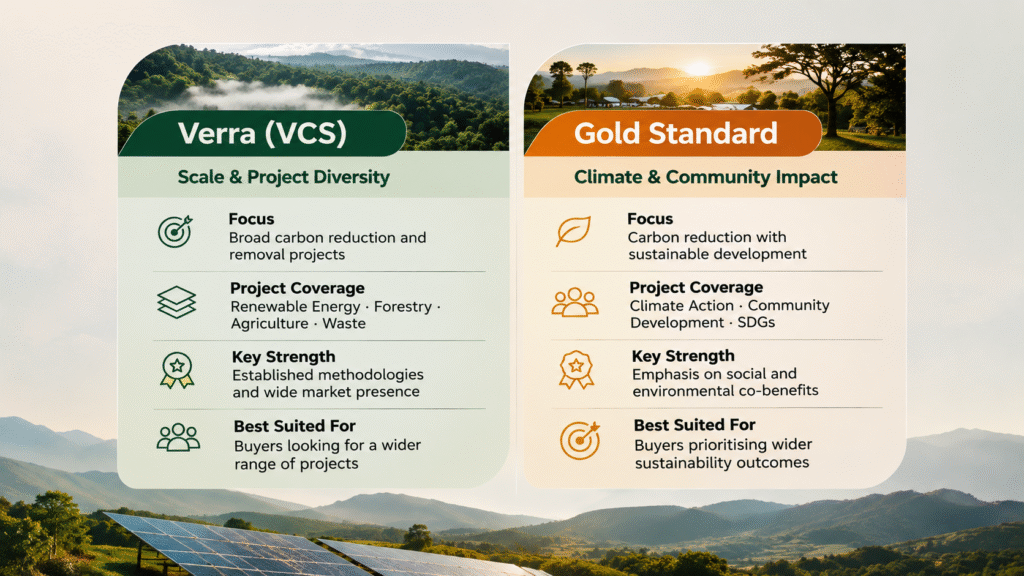
Verra: A wider range of projects
Verra operates the Verified Carbon Standard (VCS), one of the most widely used standards in the voluntary carbon market. It covers projects across renewable energy, forestry, agriculture, waste management and industrial processes.
Its wide range of methodologies allows developers from different sectors to register projects under an established framework. Verra also maintains a registry where carbon credits can be tracked from issuance through ownership to retirement.
The scale of the VCS makes it an important part of the voluntary carbon market. However, credits registered under it can vary considerably in quality. Some project categories have faced criticism over baseline calculations and additionality. Questions have also been raised about whether certain projects deliver the emissions reductions they claim.
For buyers, this means registration under Verra alone is not enough to establish the quality of a credit. The project itself needs to be examined.
Gold Standard: Carbon reduction with a focus on communities
Gold Standard was established in 2003 with support from WWF and other organisations. Its framework places considerable emphasis on sustainable development alongside climate benefits.
Projects are expected to demonstrate that they contribute to local communities and support sustainable development without causing harm. Their wider benefits are also assessed against the United Nations Sustainable Development Goals.
This approach is particularly relevant for buyers who want their carbon credit purchases to contribute to outcomes beyond emissions reduction. These may include access to clean energy and improved livelihoods for communities.
Gold Standard has a comparatively selective project portfolio. For companies looking to incorporate wider social and environmental benefits into their climate strategy, these outcomes can be an important consideration when choosing credits.
Verra vs Gold Standard
The choice between the two depends on the type of project and what the buyer wants to achieve. Verra offers a wider range of project categories, while Gold Standard places greater emphasis on sustainable development and community benefits.
Neither standard can determine the quality of every credit on its own. Buyers still need to examine the project’s methodology and supporting documentation to understand what it actually delivers.
Who rates carbon credits?
Independent rating agencies such as BeZero Carbon and Sylvera help buyers assess the credibility of carbon projects and understand the risks associated with their claimed climate impact.
They examine whether a project delivers additional emissions reductions and whether those reductions are likely to last. They also look at the possibility of emissions shifting elsewhere and assess how reliable the project’s carbon calculations are.
Ratings can differ between agencies because each follows its own assessment methodology. These ratings provide buyers with an independent perspective on project quality and help them make more informed purchasing decisions.
What should buyers check before purchasing?
Before purchasing carbon credits, buyers should look at three things:
Standard — Which framework is the project registered under? What methodology does it follow, and has it been properly verified?
Rating — Has an independent agency assessed the project? What risks or limitations have been identified?
Label — Does the project qualify for the ICVCM’s Core Carbon Principles (CCP) label, where applicable? What do its monitoring reports and project documentation say about its actual performance?
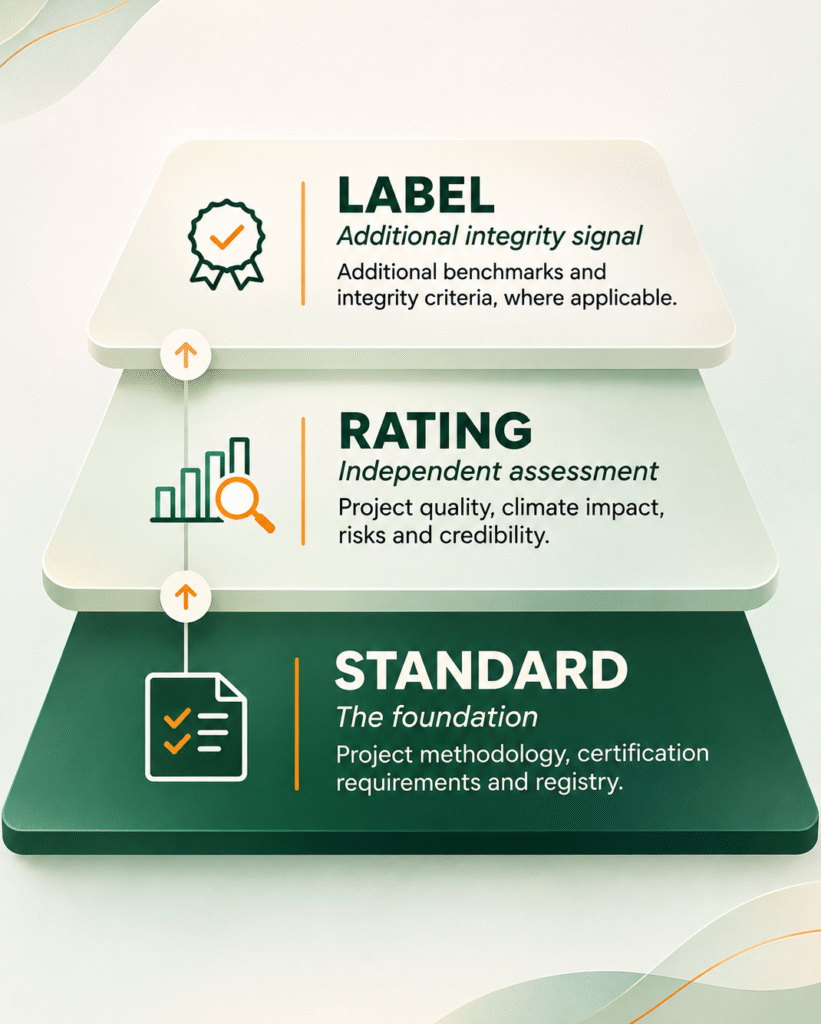
Looking at all three gives buyers a more informed picture of the credit they are purchasing. The standard establishes the requirements, the rating helps assess the project’s credibility, and the label provides an additional indication of integrity where applicable.
For anyone navigating the voluntary carbon market, understanding these distinctions is a much better starting point than relying on the name of a registry alone.