


Most businesses celebrate the drop in their electricity bills after going green, completely unaware they’re leaving lakhs of rupees on the table.
Last year, a mid-sized factory in Maharashtra swapped out its ageing boilers and put up rooftop solar.
The result? A 20% drop in their power bills. The finance team popped the metaphorical champagne, logged the savings, and moved on.
What they didn’t realise was that they had only collected half their reward. By cutting their emissions, they had created a valuable, tradable financial asset and simply walked away from it.
On paper, a carbon credit is straightforward: one credit equals one metric tonne of CO₂ kept out of the atmosphere.
In practice, you can’t just stick a bucket over a factory chimney or a solar panel and weigh invisible gas. To turn your green operations into actual money in the bank, you have to prove your impact. You need hard engineering data, strict rulebooks, and independent audits to back up your story.
If you’ve ever wondered how a solar plant, biogas unit, or energy-efficiency upgrade actually turns into cash, here is the plain-English breakdown of how it happens.
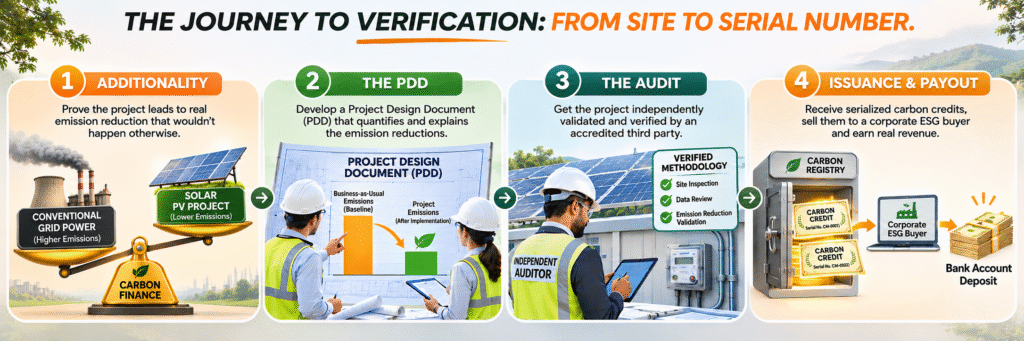
Step 1: The “Would You Have Done This Anyway?” Test
Before any carbon registry hands you a single credit, they ask one make-or-break question: Did this project actually need carbon money to happen, or were you going to build it regardless?
In the industry, this is called Additionality.
Think about swapping diesel generators for a compressed biogas plant, or adding expensive battery storage to a solar setup. The upfront costs are brutal, and the payback period can make a CFO sweat. Carbon credit revenue helps bridge that financial gap. Proving early on that your project faces real financial or technical hurdles is the single biggest factor in getting approved or getting rejected before you even start.
Step 2: Drawing Up the Blueprint
Once you pass the initial sniff test, technical specialists put together what’s called a Project Design Document (PDD).
Forget the technicalities, just think of it as the business plan for your carbon project. It maps out two things:
- Your Baseline: How much CO₂ your facility would have pumped out if you had changed nothing.
- Your Reality: How much CO₂ your clean setup emits today.
The difference between those two numbers is the exact amount of carbon credits you can claim.
Step 3: Bringing in the Referees
When it comes to carbon markets, you don’t get to grade your own homework.
Independent accredited auditors (officially called Validation and Verification Bodies) step in to check your maths. They’ll visit your site, inspect your meters and make sure you’re playing by the rules set by major registries like Verra, Gold Standard, or the Indian Carbon Market (ICM). They are there to ensure every tonne of CO₂ you claim is 100% real.
Step 4: Getting Paid
Once the auditors give you the green light, the registry issues your credits. Each credit gets its own unique digital serial number so it can never be sold twice or double counted.
Your credits then move to the market. International exchanges, domestic businesses, and corporate purchasers who want to achieve their sustainability objectives purchase them. Payouts for Indian enterprises usually range from ₹300 to ₹1,500 per credit, depending on the kind of project you conducted and the state of the market.
Don’t Stop at Power Savings
Carbon credits aren’t free magic money, they are a legitimate financial reward for measurable climate action. If your business is already putting money into Rooftop Solar, EV fleets or upgrading old factory machinery, lowering your utility bill shouldn’t be the finish line.
Not sure if your current or upcoming project makes the cut?
At Carbon Minus Energy, we take the guesswork out of the process. We run end-to-end eligibility checks, handle the heavy lifting on your PDD and audits, and help you sell your verified credits for the best possible market price.